Screen Technologies for Industrial Applications: Technical Overview (2026 Guide)
13 August, 2026
Screen Technologies for Industrial Applications: Technical Overview, E-Paper, MIP Displays, and Custom Solutions from RDS (2026 Guide)
In industrial environments—factories, outdoor signage, medical devices, logistics, defense systems, freezers, and harsh outdoor installations—display technology must prioritize reliability, sunlight readability, ultra-low power consumption, wide temperature ranges, longevity, and resistance to shock, vibration, dust, moisture, and chemicals. Consumer priorities such as peak HDR brightness or ultra-fast gaming response often take a back seat to bistable operation, zero-power static images, and ruggedization. We go through a few of the technologies out there and their pro's and cons.
Displays fall into two broad families: transmissive (LCD-based, relying on a backlight) and emissive or reflective (self-lighting or ambient-light-dependent). Below is a focused technical overview of the main technologies, with expanded coverage of e-paper and MIP (Memory-In-Pixel) displays that excel in industrial use. We also talk about how Review Display Systems (RDS) can customize these panels into complete, application-ready solutions.
LCD Family (Transmissive) – Still Core for Many Industrial HMIs
Standard LED-backlit LCDs (TN, IPS, VA), QLED (quantum-dot enhanced), and Mini-LED variants remain widely used where colour, higher refresh rates, or video are required.
- Technical notes: Liquid crystals modulate a backlight. Local dimming (especially Mini-LED with thousands of zones) improves contrast. Quantum dots expand colour gamut.
- Industrial strengths: High brightness options (up to 3,000 nits), long-life LED backlights (>70,000 hours), wide temperature ranges (−30 °C to +85 °C or better).
- Limitations: Continuous power draw for the backlight; blacks limited by light leakage; potential for backlight degradation over time.
- Typical industrial use: Machine HMIs, control panels, indoor kiosks, vehicle displays, and any application needing full-colour video or high refresh rates.
OLED and MicroLED (Emissive)
Self-emissive pixels deliver perfect blacks and high contrast. OLED (including tandem and QD-OLED) offers thin, flexible form factors and fast response. MicroLED adds inorganic durability, higher sustained brightness, and no burn-in risk, but remains costly and mainly for large or specialized installations.
Industrial relevance: Premium HMIs, medical imaging, outdoor high-brightness needs, and modular large walls. Burn-in risk and organic degradation make careful content management important for OLED in static industrial interfaces.
E-Paper (E-Ink and Similar Bistable Reflective Displays)
E-paper is a reflective, bistable technology ideally suited to industrial applications where content changes infrequently and power, readability in sunlight, and longevity are critical.
How it works technically
Microcapsules (or microcups) contain charged pigment particles suspended in a fluid. Applying an electric field rearranges the particles (black, white, and often red/yellow or multi-colour variants) to form an image. Once set, the image remains indefinitely with zero power—no continuous refresh or backlight is required. Updates consume only brief pulses of energy. Plastic substrates improve shock and vibration resistance compared with glass. Viewing is by reflected ambient light, producing a paper-like appearance with excellent contrast in bright conditions and wide viewing angles (typically 178°).
Modern variants include:
- Monochrome (B/W)
- Three- or four-colour (B/W/R, B/W/Y, B/W/R/Y)
- Larger formats up to 31+ inches
- Segmented (custom numeric/icon) and full matrix types
- Low-temperature grades for freezers (−25 °C)
Pros for industry
- Near-zero power for static content (multi-year battery or solar operation)
- Perfect sunlight readability without glare from a backlight
- Extremely long life (no backlight degradation)
- Thin, lightweight, and increasingly rugged (plastic substrates)
- Wide temperature and outdoor capability with proper sealing
Cons
- Slow refresh (full updates typically 1–30 seconds depending on colour and temperature; partial updates faster)
- Limited colour gamut and no true video capability
- Requires front-light for dark environments
Industrial use cases
Electronic shelf labels (ESL), digital nameplates, logistics tags, freezer and warehouse labels, outdoor public information boards, medical patient boards or badges, smart metering, industrial status panels, and solar-powered remote signage. Ideal wherever the image is mostly static and power or sunlight performance is paramount.
MIP Displays (Memory-In-Pixel / Memory LCD)
MIP (also known as Memory LCD or reflective LCD with embedded SRAM) is a highly efficient reflective or transflective LCD technology that bridges traditional LCD and e-paper strengths.
How it works technically
How it works technically
Each pixel contains its own static memory cell (typically SRAM). Image data is written once and retained indefinitely with zero continuous power. The display only draws current when pixels actually change. It uses a reflective (or transflective) design, so ambient light provides the illumination. An optional front-light can be added for low-light use. Interfaces are simple (often SPI). Resolutions range from low-density indicators to higher-ppi panels (e.g., 100–200 ppi). Available sizes typically run from ~1″ to 5.5″+, including square and round formats.
Pros for industry
- Ultra-low power (orders of magnitude lower than conventional TFT for static or slowly updating content)
- Always-on capability with excellent battery life
- Fast partial updates compared with many e-paper types
- Good contrast and sunlight readability
- Compact, robust, and available in industrial temperature grades
Cons
- Limited colour (often monochrome or limited greyscale/colour depth)
- Lower resolution and size range than mainstream TFTs
- Still requires a driver and careful power management for maximum efficiency
Industrial use cases
Always-on status indicators, medical patches and wearables, smart thermostats, industrial meters and sensors, remote controls, portable instruments, logistics scanners, bicycle computers, and any
battery- or energy-harvesting device needing a persistent, readable display with minimal power draw.
RDS Customization Capabilities for Industrial Displays
Off-the-shelf panels rarely meet the full requirements of industrial, medical, defense, or outdoor projects. Review Display Systems (RDS) specializes in turning standard or semi-custom e-paper, MIP, TFT, OLED, and other panels into fully engineered, application-ready solutions. Key customization areas include:
Backlighting / Front-Lighting
- Custom LED front-lights for e-paper and MIP (uniformity >70 %, optimized for night or indoor use without destroying the reflective advantage)
- High-brightness, long-life LED backlights for TFT/Mini-LED (extended lifetime, high nits for sunlight)
- Controllable dimming and power management for battery or solar operation
Cover Glass & Optical Treatments
- Chemically strengthened glass (Gorilla Glass equivalents or similar) in thicknesses from 0.7 mm to several mm, with IK impact ratings
- Anti-glare, anti-reflective, anti-fingerprint, and matte finishes
- Optical bonding (LOCA or OCA) to eliminate air gaps, improve contrast, reduce reflections, and increase ruggedness
- Custom silk-screen printing for borders, logos, instructions, or full branding
- UV-protective coatings and materials (meeting standards such as ASTM G154 / MIL-STD-810H for prolonged outdoor exposure)
- Anti-bacterial / anti-microbial coatings for medical, food-processing, and high-touch public devices
Touch Solutions
- Projected Capacitive (PCAP) with multi-touch, gloved-hand, and water-rejection support; thick cover-glass compatibility
- Resistive touch for harsh environments or stylus use
- Custom controllers, firmware tuning, and integration of additional capacitive buttons or zones on the same cover glass
- Optical or tape bonding of touch sensors
Mounting, Mechanical Integration & Enclosures
- Custom aluminum, stainless-steel, or plastic frames and bezels
- IP65 / IP67 front sealing and full enclosures for outdoor or wash-down use
- VESA, panel-mount, DIN-rail, open-frame, and fully custom metalwork
- Ruggedization for shock, vibration, and extreme temperatures (−40 °C to +85 °C or wider)
Drivers, Electronics & System Integration
- Custom driver boards, interface conversion (SPI, LVDS, MIPI, HDMI, etc.), and power-management circuitry
- Integration with ESP32, ARM, x86, or other embedded platforms, including wireless (BLE, LoRa, 4G/5G, Wi-Fi) and energy harvesting (solar MPPT, super-caps)
- Full firmware/BSP support, optical bonding in cleanroom facilities, and complete turnkey assemblies
- Long-term availability, locked BOMs, and industrial-grade component selection
RDS combines in-house UK engineering, cleanroom assembly, mechanical design, and direct relationships with panel manufacturers. This enables non-catalogue sizes, extended temperature grades, special colour variants, and full vertical integration—from prototype to volume production with the required certifications (including medical ISO 13485 pathways).
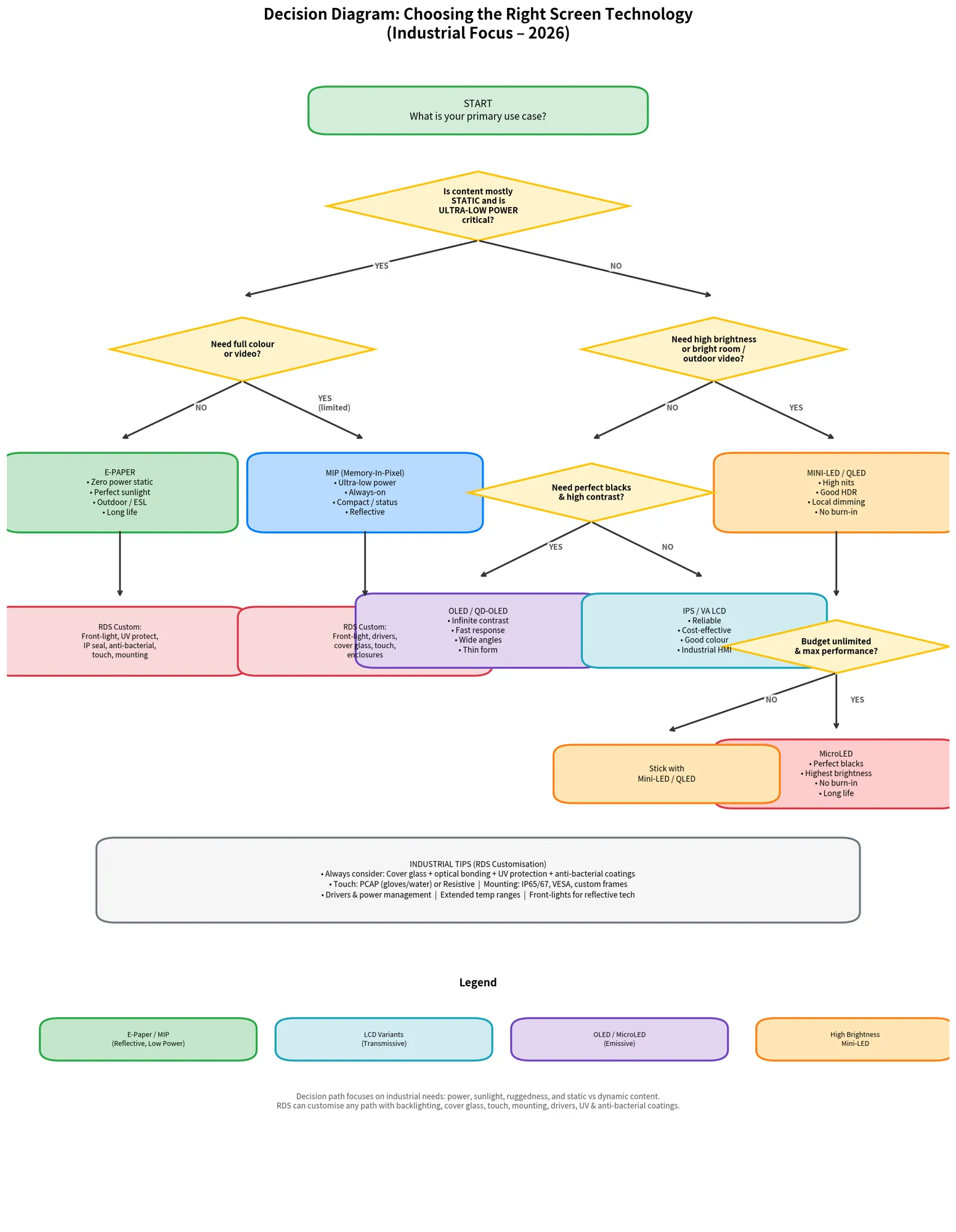
Choosing and Deploying for Industrial Success
- Static or slowly updating content + extreme power constraints or outdoor sunlight → E-paper (with RDS front-light, UV protection, IP sealing, and custom cover glass).
- Always-on status / ultra-low-power compact indicators → MIP (with RDS touch, custom drivers, and mechanical integration).
- Full-colour video, higher refresh, or complex GUIs in controlled environments → High-brightness IPS/VA TFT or Mini-LED with optical bonding and industrial touch.
- Premium contrast and thin form factors → OLED or MicroLED where budget and content management allow.
By combining the right core technology with RDS’s customization stack—backlighting/front-lighting, cover glass, touch, mounting, drivers, UV protection, and anti-bacterial coatings—industrial displays can be engineered for decade-long reliability in the most demanding real-world conditions. Whether you need a coin-cell-powered medical badge, a solar outdoor e-paper sign, a sunlight-readable factory HMI, or a fully sealed multi-year logistics terminal, the combination of these technologies and specialist industrialization delivers solutions that standard consumer panels simply cannot match.