Night Vision Systems: A Review of Display Technologies and Their Applications
Night Vision Systems: A Review of Display Technologies and Their Applications
Night vision systems have revolutionised operations in low-light and dark environments, enabling enhanced visibility for military, law enforcement, wildlife observation, and civilian applications. Central to these systems are advanced display technologies that present amplified or processed imagery to users. Today we will explore the types of display systems used in night vision, their functionalities, and the diverse applications that leverage these technologies.
Overview of Night Vision Systems
Night vision systems enable visibility in low-light conditions by amplifying available light (e.g., starlight, moonlight) or detecting infrared (IR) radiation to generate visible images. These systems typically incorporate an image intensifier tube, thermal imaging sensor, or both, coupled with a display to present processed imagery. The display’s quality is crucial, as it affects situational awareness, user comfort, and operational efficiency. Night vision devices (NVDs), such as those used by U.S. military forces, consist of an infrared (IR) image intensifier tube in a rigid casing. Infrared light, with wavelengths between 0.7 and 300 micrometers (approximately 1 to 430 terahertz), is key to their operation.
Night vision goggles (NVG) paired with magnification lenses form night vision binoculars, while monocular devices with a single eyepiece can be mounted on firearms as night sights. NVG and enhanced vision systems (EVS) are standard in U.S. military operations for improved safety. Night Vision Imaging System (NVIS) compliant lighting, available in six colours—NVIS blue, NVIS green A, NVIS green B, NVIS white, NVIS yellow, and NVIS red—ensures compatibility with NVIS. The chromaticity coordinates for NVIS blue, green A, and white displays fall within specified circular boundaries, and green B, yellow, and red are bounded by a circle and the spectrum locus, measured at 0.1 foot-lamberts for blue, green A, and white, and 15.0 foot-lamberts for yellow and red. NVIS red is popular in hunting, while NVIS green was historically used in military aviation and ground units. NVIS white is increasingly adopted due to cost-effective LED technology offering high contrast and wide-spectrum performance.
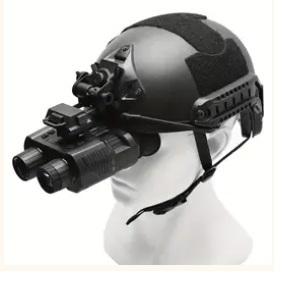
NVIS are passive systems with high sensitivity to radiation in the 600nm to 930nm range (orange to near-infrared), amplifying night time scenes approximately 2,000 times. They convert photons from the night scene into a micro-displayed visible image. To prevent damage, NVIS feature automatic gain control (AGC), which reduces sensitivity when exposed to bright lights in the 600nm to 930nm range. Non-NVIS-compatible displays or light sources can trigger AGC, reducing sensitivity to external night time objects. Light-emitting diodes (LEDs) in NVIS must minimise near-infrared (NIR) noise to avoid interfering with NVG night time sensitivity. Night vision compatibility (NVC) requires lighting designs that function effectively with and without NVIS, day or night. The MIL-STD-3009 standard governs NVIS specifications.
Types of Display Systems in Night Vision
Night vision systems employ various display technologies, each tailored to specific use cases and performance requirements. Below are the primary display systems used:
-
Phosphor Screen Displays (Image Intensifiers)
Traditional night vision devices, such as monoculars and goggles, use phosphor screens to display amplified light.
- How It Works: An image intensifier tube amplifies incoming photons, converting them into electrons that strike a phosphor screen, producing a green or white glowing image.
-
Advantages:
- High resolution and clarity in low-light conditions.
- Lightweight and power-efficient, ideal for head-mounted devices.
- Proven reliability in rugged environments.
-
Limitations:
- Limited to green or white monochrome imagery, which can cause eye fatigue over extended use.
- Susceptible to blooming or halo effects around bright light sources.
- Examples: AN/PVS-14 night vision monocular, PVS-31A binocular night vision goggles.
-
Micro-OLED and AMOLED Displays
Modern night vision systems increasingly incorporate organic light-emitting diode (OLED) or active-matrix OLED (AMOLED) displays, often used in digital night vision or fused systems.
- How It Works: Digital sensors capture light or thermal data, which is processed and displayed on a high-resolution micro-OLED or AMOLED screen, typically integrated into headsets or weapon-mounted sights.
-
Advantages:
- Full-color or customisable display options (e.g., green, white, or grayscale).
- High contrast and deep blacks for enhanced image quality.
- Supports overlays, such as augmented reality (AR) data, maps, or targeting.
-
Limitations:
- Higher power consumption compared to phosphor screens.
- Potentially less durable in extreme conditions unless ruggedised.
- Examples: ENVG-B (Enhanced Night Vision Goggle-Binocular), ATN X-Sight digital night vision scopes.
-
LCD Displays
Liquid crystal displays (LCDs) are used in some digital night vision systems, particularly in budget-friendly or handheld devices.
- How It Works: Processed imagery from a digital sensor is displayed on an LCD screen, often in scopes or cameras.
-
Advantages:
- Cost-effective and widely available.
- Supports color imagery and digital enhancements (e.g., zoom, recording).
-
Limitations:
- Lower contrast and slower refresh rates compared to OLED.
- Limited performance in extreme temperatures.
- Examples: Budget digital night vision scopes, consumer-grade trail cameras.
-
Head-Up Displays (HUDs) and Augmented Reality (AR) Integration
Advanced night vision systems integrate with HUDs or AR displays, projecting imagery and data onto transparent visors or glasses.
- How It Works: Night vision imagery, thermal data, or AR overlays are projected onto a waveguide or combiner lens, allowing users to see both the enhanced image and the real world simultaneously.
-
Advantages:
- Hands-free operation and enhanced situational awareness.
- Integration with navigation, targeting, or communication systems.
- Reduces the need to look down at separate screens.
-
Limitations:
- High cost and complexity.
- Limited field of view in some designs.
- Examples: IVAS (Integrated Visual Augmentation System) for military use, HoloLens-based night vision prototypes.
-
Thermal Imaging Displays
Thermal night vision systems use microbolometer sensors to detect heat signatures, displaying imagery on OLED, LCD, or specialised thermal displays.
- How It Works: Heat signatures are converted into grayscale or color-coded images, with warmer objects appearing lighter or in distinct colors.
-
Advantages:
- Effective in total darkness, fog, or smoke, where image intensifiers fail.
- Customisable color palettes for specific applications (e.g., white-hot, black-hot, rainbow).
-
Limitations:
- Lower resolution compared to image intensifiers.
- Higher power consumption in uncooled systems.
- Examples: FLIR Scout thermal monocular, Trijicon REAP-IR thermal weapon sights.
Applications of Night Vision Display Systems
Night vision systems with advanced display technologies serve a wide range of applications, each leveraging specific display features for optimal performance:
-
Military and Defense
- Use Case: Nighttime reconnaissance, target acquisition, and navigation in combat zones.
- Display Systems: Phosphor screens in goggles (e.g., PVS-14), micro-OLED in fused systems (e.g., ENVG-B), and AR HUDs (e.g., IVAS) for real-time battlefield data.
- Benefits: Enhanced situational awareness, integration with weapon systems, and operation in diverse environments.
- Example: Soldiers use ENVG-B to combine thermal and image-intensified imagery, with overlays for friendly force locations.
-
Law Enforcement and Search and Rescue
- Use Case: Surveillance, pursuit in low-light urban areas, and locating missing persons in darkness or dense environments.
- Display Systems: Thermal displays for detecting heat signatures, OLED-based digital scopes for clarity.
- Benefits: Ability to detect suspects or victims through foliage or in total darkness.
- Example: Police use FLIR thermal monocular to track suspects hiding in wooded areas.
-
Wildlife Observation and Conservation
- Use Case: Monitoring nocturnal animals, tracking migration patterns, and preventing poaching.
- Display Systems: LCD or OLED in digital night vision cameras, thermal displays for heat-based tracking.
- Benefits: Non-invasive observation, ability to record and analyse footage.
- Example: Conservationists use ATN X-Sight scopes to monitor endangered species at night.
-
Hunting and Outdoor Recreation
- Use Case: Tracking game animals or navigating wilderness areas at night.
- Display Systems: OLED-based digital scopes, thermal displays for spotting game in dense cover.
- Benefits: High-resolution imagery, digital features like video recording and ballistic calculators.
- Example: Hunters use Pulsar Thermion thermal scopes to detect animals in complete darkness.
-
Aviation and Maritime Operations
- Use Case: Nighttime navigation, obstacle avoidance, and search operations.
- Display Systems: HUDs with night vision integration, thermal displays in cockpit or bridge systems.
- Benefits: Enhanced visibility in low-light or foggy conditions, integration with navigation systems.
- Example: Helicopter pilots use night vision goggles with phosphor screens for low-altitude night flights.
-
Consumer and Civilian Use
- Use Case: Home security, camping, or amateur night photography.
- Display Systems: LCD in budget digital night vision devices, smartphone-compatible displays.
- Benefits: Affordable access to night vision, user-friendly interfaces.
- Example: Homeowners use cameras for nighttime property monitoring.