Understanding Touch Technologies: Choosing the Right Interface for Your Application
24 March, 2026
Touch technology has transformed the way users interact with electronic systems. From industrial control panels and medical devices to transportation systems and smart infrastructure, touch interfaces provide an intuitive and efficient method of human-machine interaction.
However, selecting the right touch technology for a product requires careful consideration of the application environment, user behaviour and system design. Different technologies offer distinct advantages in terms of durability, responsiveness, optical clarity and environmental resilience.
At Review Display Systems, we support OEMs in selecting and integrating the most appropriate touch solution for their products, ensuring optimal usability, reliability and long-term performance.
The Role of Touch Interfaces in Modern Product Design
Touchscreens simplify system interaction by replacing physical buttons, switches and keypads with dynamic graphical interfaces. This allows engineers to create flexible user interfaces that can evolve with software updates and new product features.
Touch interfaces are now widely used in applications such as:
- Industrial human-machine interfaces (HMIs)
- Medical equipment and diagnostics systems
- Transportation and ticketing systems
- Self-service kiosks and digital signage
- Test and measurement equipment
- Clean Energy Systems
Advances in sensing technology, controller electronics and optical bonding techniques have significantly improved the durability and responsiveness of modern touch solutions.
Key Touch Technologies
A range of touch technologies are available, each suited to different operating environments and user requirements.
Projected Capacitive (PCAP)
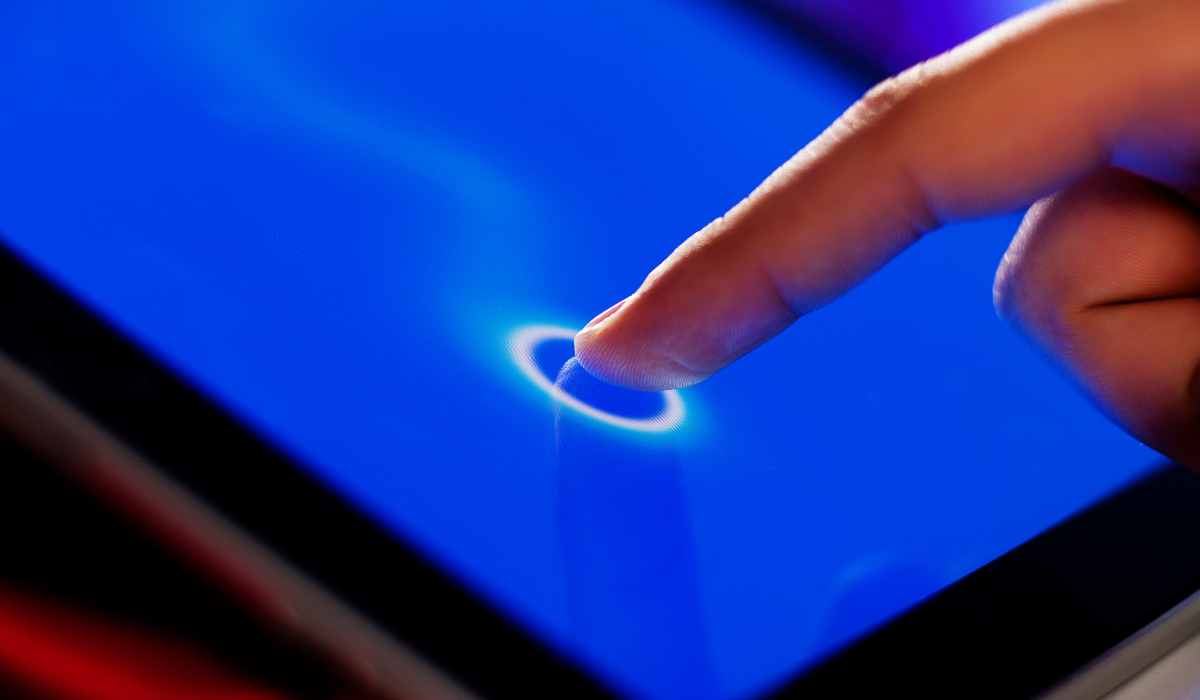
Projected capacitive touch is now the most widely used technology in modern touch devices. It detects touch by measuring changes in capacitance when a conductive object such as a finger interacts with the sensor grid embedded in the glass surface.
This technology supports highly responsive multi-touch gestures and excellent optical clarity, making it ideal for applications that require sophisticated user interfaces.
Key benefits include:
- Multi-touch capability
- High durability with glass surfaces
- Excellent optical performance
- Fast and accurate touch response
Projected capacitive touchscreens are commonly used in smartphones, tablets, kiosks and modern industrial HMIs.
Resistive Touch
Resistive touch technology operates differently, detecting touch when pressure causes two conductive layers within the screen to make contact.
Because it relies on pressure rather than electrical conductivity, resistive touchscreens can be operated using fingers, gloves, styluses or other objects.
Advantages include:
- Works with gloves or stylus input
- Reliable operation in challenging environments
- Cost-effective implementation
For this reason, resistive technology continues to be used in industrial and medical systems where precision stylus input or gloved operation is required.
Infrared Touch
Infrared touch technology uses a grid of invisible infrared light beams across the screen surface. When a finger or object interrupts the beams, the system detects the touch location.
This approach allows touch detection without a physical sensor layer over the display, helping maintain excellent image clarity.
Infrared touch solutions are often used in:
- Large interactive displays
- Public kiosks
- Digital signage systems
Surface Capacitive Touch
Surface capacitive touchscreens use a conductive coating on the screen that responds to electrical charge from a finger.
They offer good optical clarity and durability, but typically require bare-finger operation, making them less suitable for environments where users wear gloves.
Designing Touch Interfaces for Real-World Environments
While touch technology can dramatically improve usability, its performance must be carefully engineered to suit the application environment.
Important considerations include:
Environmental Conditions
Temperature fluctuations, moisture, dust and contaminants can all affect touch performance. Industrial environments often require additional protection such as:
- Sealed front panels
- Ruggedised glass
- IP-rated enclosures
Optical Performance
Touch sensors add additional layers above the display, which can affect brightness, contrast and viewing angles.
Techniques such as optical bonding help minimise reflections and improve readability, particularly in bright or outdoor environments.
User Interaction
The intended user and operating conditions also influence technology selection. For example:
- Gloves may require resistive or specially tuned capacitive touch
- Multi-touch gestures favour projected capacitive technology
- Stylus-based interaction may benefit from resistive or active capacitive solutions
- Hygiene and anti-bacterial for medical solutions.
Designing with the end user in mind ensures that the final interface is both intuitive and reliable.
Engineering Touch Solutions with Review Display Systems
At Review Display Systems, we work closely with OEM customers to deliver touch solutions that integrate seamlessly into their products.
Our engineering team supports projects from early concept through to full production, providing expertise in:
- Touch technology selection
- Controller integration
- Optical bonding and display enhancement
- Environmental protection and ruggedisation
- Mechanical and electrical system integration
By combining display technology, embedded systems and mechanical design expertise, we help customers develop robust human-machine interfaces for demanding applications.
From Prototype to Production
Touch technology is rarely a standalone component - it forms part of a larger system that includes the display, enclosure, electronics and software.
Our engineering-led approach ensures these elements are considered together during product development. This reduces design risk, improves manufacturability and helps bring products to market more efficiently.
Whether developing a compact embedded interface or a large industrial control display, our team can help deliver a touch solution tailored to your application.