Revolutionising Patient Care: E-Paper Displays in Hospitals and Medical Settings
28 October, 2025
Revolutionising Patient Care: E-Paper Displays in Hospitals and Medical Settings
In the fast-paced environment of modern healthcare, clear, reliable, and up-to-date information is critical for patient safety, staff efficiency, and overall operational smoothness. Traditional paper charts, whiteboards, or even basic digital screens at the ends of hospital beds or on room doors have long served this purpose—but they come with limitations like frequent updates, high maintenance, and energy consumption. Enter e-paper displays: low-power, sunlight-readable screens that mimic the appearance of ink on paper, offering a game-changing solution for displaying patient information, room statuses, and more. Review Display Systems are at the forefront, providing customisable e-paper solutions tailored to the unique demands of medical applications.
The Rise of E-Paper in Healthcare
E-paper technology, also known as electronic ink, has evolved significantly since its inception in the late 1990s. Unlike traditional LCD or OLED screens that require constant power to maintain an image, e-paper only consumes energy when the display content changes. Once updated, the image remains visible indefinitely without power, making it ideal for battery-operated or energy-efficient devices. In hospitals, where power outages or conservation are concerns, this bistable nature ensures information persists even during disruptions.

Key advantages for medical use include:
Exceptional Readability: E-paper reflects ambient light like real paper, eliminating glare and backlight issues. This is crucial in brightly lit hospital corridors or patient rooms with varying lighting conditions.
Ultra-Low Power Consumption: Displays can run for weeks or months on a single charge, reducing wiring needs and maintenance.
Durability and Hygiene: Many e-paper panels are rugged, waterproof (often IP-rated), and easy to clean with hospital-grade disinfectants, aligning with strict infection control protocols.
Flexibility in Size and Form: From small 1.5-inch tags for wristbands to large 13-inch+ panels for bed- end charts or door signs.
These features make e-paper a natural fit for patient-facing and staff-oriented displays in hospitals, clinics, and long-term care facilities.
Patient Information at Bed Ends
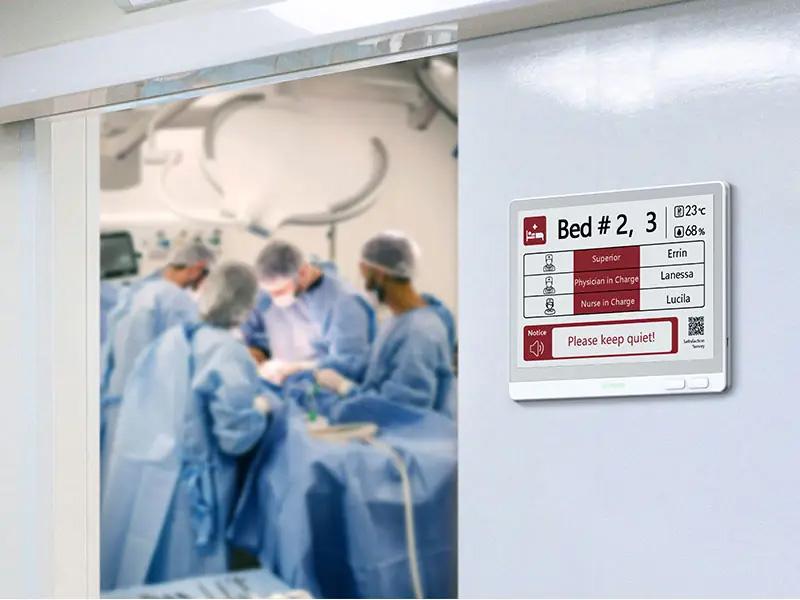
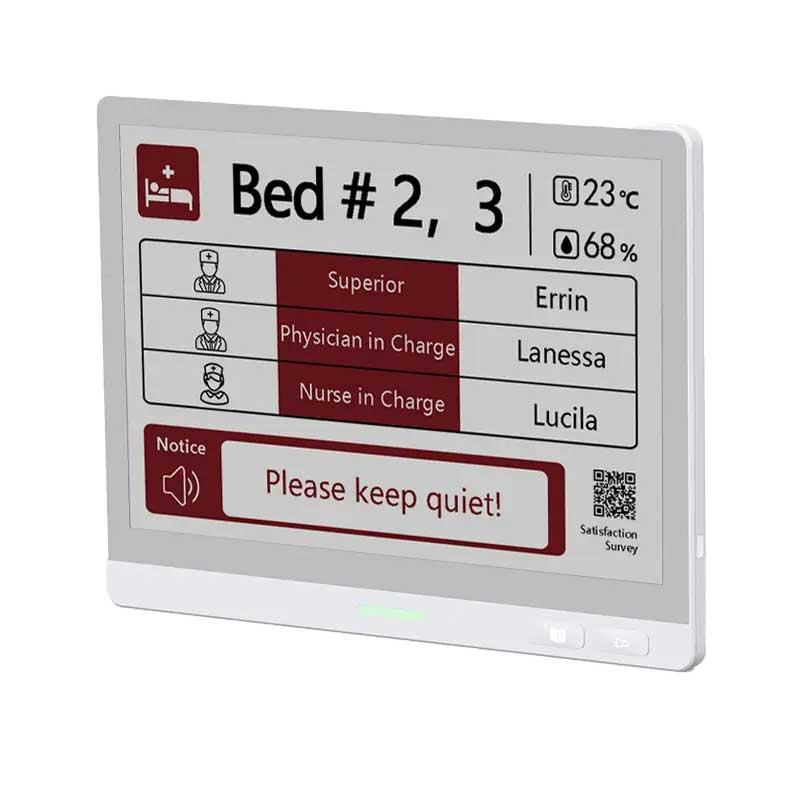
One of the most impactful applications is at the bedside. Traditionally, a clipboard or printed sheet at the foot of the bed lists vital details: patient name, age, allergies, medications, care plan, physician notes, and isolation precautions. Manual updates are time-consuming, prone to errors, and can lead to compliance issues under regulations like HIPAA in the US or GDPR in Europe.

E-paper bed-end displays transform this:
Real-Time Updates: Integrated with electronic health records (EHR) systems, displays automatically refresh with new data—e.g., when a nurse administers medication or a doctor updates orders.
Colour-Coded Alerts: Subtle colour changes (many modern e-paper supports colours like red for allergies or yellow for fall risks) provide instant visual cues without overwhelming the paper-like aesthetic.
Multilingual Support: For diverse patient populations, information can switch languages on demand.
Privacy Features: Screens can include privacy filters or timed dimming to protect sensitive data when not in use.
A study from the Journal of Medical Internet Research highlights how digital bed-end displays reduce medication errors by up to 20% through better visibility and accuracy. E-paper takes this further by being always-on yet energy-sipping, unlike power-hungry tablets.
Room Information and Wayfinding
Beyond individual beds, e-paper shines in hospital room doors and hallways:
Room Status Boards: Display occupancy, cleaning status (e.g., “Ready for Admission” or “Isolation Required”), scheduled procedures, or staff assignments.
Dynamic Signage: In emergency departments or ICUs, doors can show real-time patient acuity levels or transport needs.
Integration with Building Management: Linked to HVAC or lighting systems, displays can indicate room temperature, air quality, or energy-saving modes.
This reduces verbal handoffs, minimises disruptions, and enhances workflow. For instance, during outbreaks like COVID-19, e-paper door signs quickly flagged isolation rooms without reprinting labels.
Customisation by Review Display Systems
Not all hospitals are alike — pediatric wards need playful interfaces, while oncology units prioritse discreet alerts. This is where specialists like Review Display Systems excel in customising e-paper solutions.
Review Display Systems (RDS), a UK-based expert in display technologies, offers end-to-end customisation:
Hardware Tailoring: Select from a range of E Ink or similar e-paper modules (e.g., 4.2-inch to 32-inch sizes) with options for touch, NFC for quick scans, or wireless connectivity (Wi-Fi, Bluetooth Low Energy, or LoRa for low-bandwidth hospital networks).
Software Integration: RDS develops bespoke firmware and APIs to seamlessly connect with existing hospital IT infrastructure. For bed-end units, this might include HL7 protocol support for EHR syncing or custom dashboards showing vital signs from connected monitors.
Design for Specific Needs:
Pediatric Applications: Bright, icon-based layouts with larger fonts and gamified elements to reduce child anxiety.
Geriatric Care: High-contrast modes and voice-assisted updates via integrated speakers.
Surgical Suites: Sterilisable, antimicrobial coatings and glove-friendly touch layers.
Scalability and Compliance: Solutions are designed to meet medical standards like IEC 60601 forelectrical safety and FDA Class I/II device guidelines where applicable. RDS provides prototyping, testing, and deployment support, ensuring minimal disruption during installation.
Sustainability Focus: By optimising power usage and using recyclable materials, these systems align with green healthcare initiatives.
Case in point: Customised e-paper systems in NHS trusts, where bed-end displays reduced nursing update time by 15 minutes per shift, per internal audits. Their modular approach allows hospitals to start small (e.g., pilot in one ward) and scale network-wide.
Challenges and Future Outlook
While promising, adoption isn’t without hurdles. Initial costs can be higher than paper, and integration requires IT expertise. Cybersecurity is paramount—e-paper devices must encrypt data in transit. However, falling e-paper prices (down 50% in the last decade) and ROI from efficiency gains are accelerating uptake.
Looking ahead, advancements like flexible e-paper or full-color variants (e.g., E Ink Spectra) will enable richer visuals, such as anatomical diagrams or progress graphs. Combined with AI for predictive alerts (e.g., flagging potential sepsis), e-paper could evolve into intelligent patient companions.
Conclusion
E-paper displays are poised to become a staple in hospitals, offering a blend of reliability, efficiency, and patient-centered design for bed-end patient info, room signage, and beyond. With customisation leaders like Review Display Systems adapting solutions to precise medical workflows, healthcare providers can achieve safer, smarter environments. As technology matures, these “digital paper” innovations will not just display information—they’ll enhance care delivery, one refresh at a time. Hospitals investing now are future-proofing for a more connected, compassionate era of medicine.