From Concept to Production: Building a Complete Kiosk System
23 September, 2026
Developing a kiosk involves much more than selecting a display and putting it into an enclosure.
A successful kiosk brings together mechanical design, display technology, embedded computing, connectivity, power, software and manufacturing. Each element needs to work with the others, while the finished product also needs to be practical to manufacture, maintain and deploy.
For companies developing a bespoke kiosk, working with a partner that can take responsibility for the complete system can simplify this process.
RDS provides end-to-end engineering and manufacturing support, covering concept development, prototyping, component integration, testing and production.
Why a complete system approach matters
When different parts of a kiosk are developed separately, integration can become a challenge.
The selected display may not fit the enclosure as expected. The embedded computer may generate more heat than anticipated. Cable routing may become difficult once all the peripherals are installed. Access for servicing may also be overlooked during the initial design.
These issues are easier to identify when the kiosk is treated as a complete system from the beginning.
Mechanical and electronic design can be developed together, allowing decisions about the enclosure, display, computing platform, connectivity and internal layout to be made with the finished product in mind.
Designing around the real application
Every kiosk has different requirements.
A self-service kiosk may need a large touchscreen and payment functionality. An information kiosk may prioritise visibility and accessibility. A healthcare or hospitality application may require a combination of information delivery, POS functionality and a robust enclosure.
The environment also affects the design. A kiosk deployed in a busy public space may need impact-resistant materials and a construction capable of handling repeated use. A system positioned near windows may require a high-brightness, sunlight-readable display.
RDS's kiosk and retail capabilities cover displays, embedded systems, connectivity, IoT and engineering support, allowing these requirements to be considered together.
From concept to prototype
Prototyping provides an opportunity to test more than whether the electronics work.
A physical prototype can reveal issues with ergonomics, screen position, enclosure size, access to internal components, weight and stability. It also gives the customer an opportunity to assess the finished concept before committing to production.
This approach was demonstrated in a recent bespoke kiosk project for a healthcare customer.
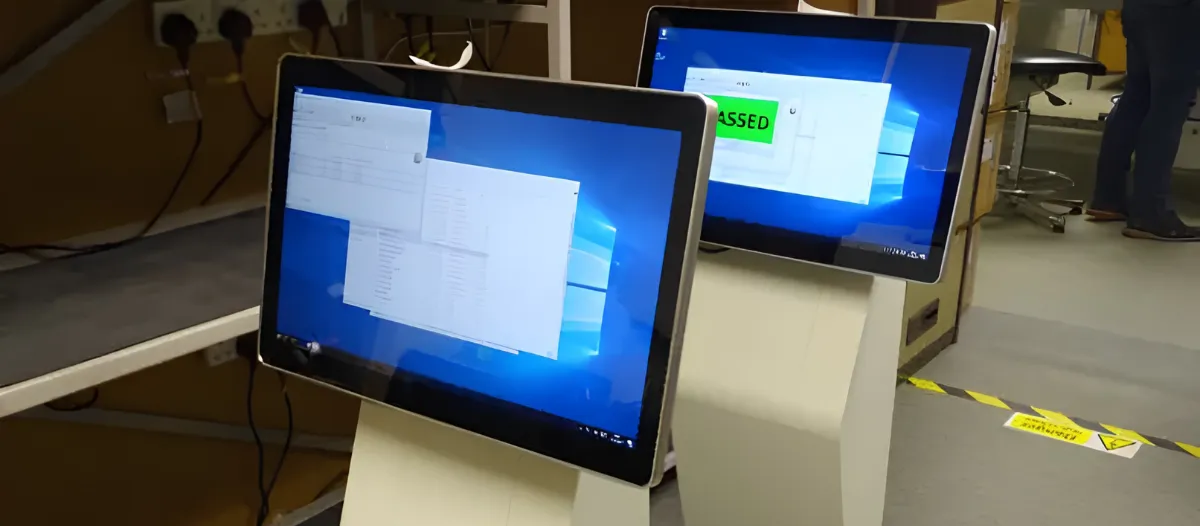
Case study: a bespoke kiosk designed for healthcare
The customer required a self-service kiosk that could combine information delivery and point-of-sale functionality within a robust unit suitable for constant daily use.
The requirements included a 21.3-inch touch display, sunlight-readable performance, a durable metal enclosure, a smash-resistant front panel and an embedded PC capable of running Windows and the customer's application software.
Rather than adapting an existing kiosk, RDS developed the system from the ground up.
The mechanical and electronic design was developed together using SolidWorks, with particular attention given to structural strength, user interaction, internal component layout and serviceability.
A one-off prototype was then produced so the customer could assess the physical and functional design before moving into production.
Turning the prototype into a production system
Once the prototype had been approved, the project moved into production.
The customer commissioned an initial batch of 50 units, manufactured at RDS's facility in Westerham, UK. RDS managed the production lifecycle, including component sourcing, assembly, quality control and preparation for deployment.
This is an important part of developing bespoke kiosk technology. A design that works as a prototype still needs to be practical to manufacture consistently.
Considering production requirements early in the development process can help avoid costly redesigns later and provides a clearer route from the first prototype to a repeatable production build.
More than a collection of components
A kiosk is ultimately a single product, even though it contains many different technologies.
The display, touchscreen, computer, enclosure, cabling and peripherals all need to work together. The mechanical design needs to protect the electronics without making the product unnecessarily large or difficult to service. The embedded platform needs to provide sufficient performance while fitting within the available space.
This is why system-level engineering can be valuable for kiosk and retail projects.
RDS's approach combines display technology, embedded computing, mechanical engineering, connectivity and manufacturing support to develop complete systems rather than treating each element as a separate project.
Supporting the complete project
For businesses developing a new kiosk, the technical challenge is not simply finding the right screen or computer. It is making sure all the individual elements come together in a product that works reliably in its intended environment and can be manufactured at the required scale.