AI in Medical Technology: Next-Generation Hardware Platforms for Data-Intensive Healthcare
25 June, 2026
Digitalisation is fundamentally transforming the healthcare sector. The increasing connectivity of medical devices, clinical IT systems, and mobile applications is generating enormous amounts of data, opening up new possibilities for diagnostics, treatment, and research. Artificial Intelligence plays a key role in this evolution. Modern Ai algorithms can analyse large amounts of data in a very short time, recognise complex patterns, and support medical professionals in making critical diagnostic decisions.
The potential of these technologies is particularly evident in medical imaging. AI algorithms can analyse X-ray, CT, or MRI images and identify abnormalities that are difficult for the human eye to detect, allowing for faster diagnoses while simultaneously increasing accuracy. In the future, AI systems will increasingly combine various data sources such as image data, genetic information, or clinical patient data. This comprehensive data analysis enables more precise diagnoses, personalised treatment approaches, and earlier detection of diseases.
To support these demanding clinical workloads, RDS supplies a comprehensive range of flexible, reliable, and high-performance industrial computing platforms designed specifically for digital healthcare applications.
High Demands on Medical IT Hardware
As the deployment of AI increases, so do the demands on the underlying hardware architecture. Medical applications must process massive datasheets in real time while meeting the highest standards of reliability, security, and availability. Typical operational requirements in clinical environments include:
- Parallel Processing & GPU Acceleration: High performance graphic cards, such as NVIDIA GPUs, are required to accelerate machine learning training and interference processes. They also enable real-time analysis directly within the operating room and improve image quality in CT and MRI scans, even at lower radiation doses.
- 24/7 System Availability: Continuous operation under demanding conditions ensures the availability of critical applications such as patient monitoring or emergency diagnostics.
- Scalability & Interoperability: Systems must scale seamlessly to handle growing data volumes while maintaining secure, networked data exchange across existing hospital IT infrastructures.
- Clinical Environment Optimisation: Hardware must comply with strict security and compliance standards, offer long-term lifecycle availability, and provide whisper-quiet operation to avoid disrupting patient-facing areas.
Technical Specifications of the Industrial Computing Range
The hardware range supplied by RDS delivers high computing power up to 14th Gen Intel Core i9/i7/i5/i3 processors, enabling fast and precise analysis of large medical datasets. The systems are engineered with modular expandability and flexible installation profiles to facilitate effortless integration into hospital IT, equipment cabinets, and mobile medical systems.
1. Compact Industrial Box PCs
Designed for space-constrained installations, wall mounting, or direct integration into mobile medical carts, the compact box PC form factor provides resilient, high-performance computing.
- Processing Power: Equipped with 14th Gen Intel Core i9/i7/i5/i3 processors for localised AI applications and data processing.
- Thermal & Noise Management: Features efficient, maintenance-free, and exceptionally quiet cooling architectures, allowing deployment directly in patient-facing clinical environments.
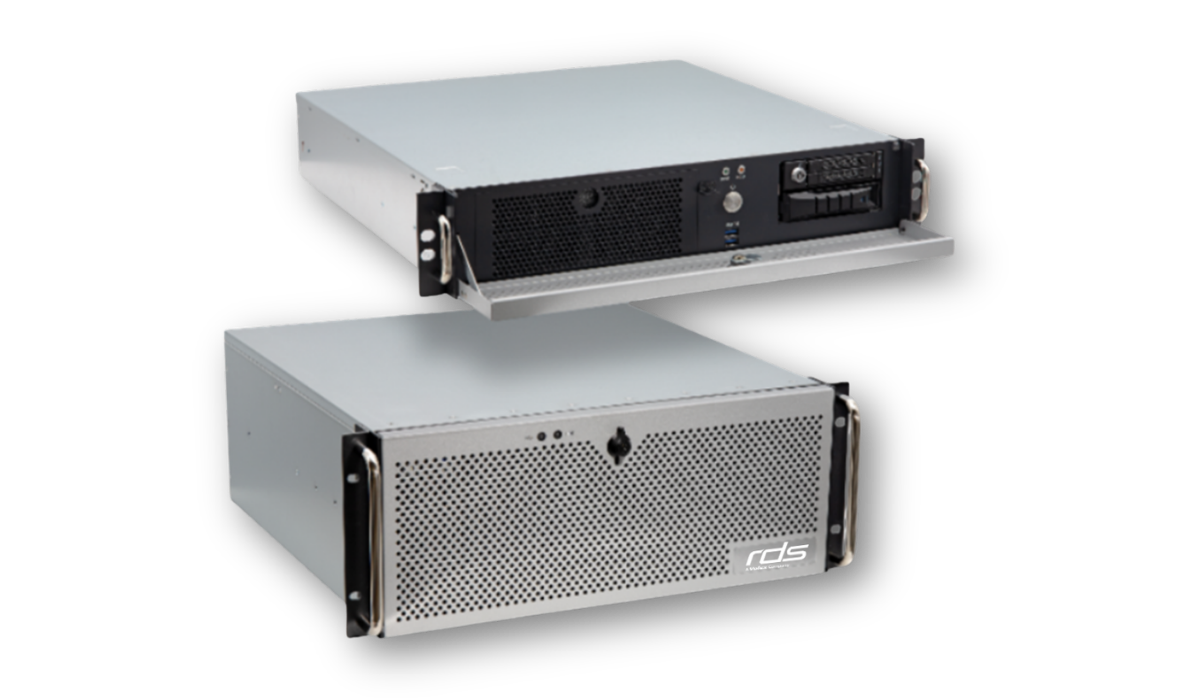
2. Rackmount Server Systems
For centralised infrastructure, data-intensive processing hubs, and equipment cabinets, the industrial-grade rackmount server range offers robust scalability and high availability.
- Flexible Chassis Options: Available in standard 1U, 2U, and 4U rackmount configurations to fit varied server room and clinical IT deployments.
- Processor Architecture: Built around 14th Gen Intel Core i9/i7/i5/i3 processing units to handle complex algorithmic loads simultaneously.
- Acoustic Tuning: Explicitly optimised for noise-sensitive medical environments, ensuring high-density computing does not compromise ambient clinical noise levels.
3. High-Performance Workstations
Engineered specifically for heavy graphics processing, deep learning model execution, and advanced diagnostics, the compact workstation series bridges the gap between local edge devices and centralised servers.
- Target Workloads: Optimised for machine learning workflows, advanced AI training/inference, and graphics-intensive medical imaging applications.
- GPU & Acceleration Ready: Supports powerful dedicated GPUs (e.g. NVIDIA) for accelerated inference processes and real-time intraoperative analysis.
Enterprise-Grade Reliability and Lifecycle Security
Medical devices feature long development, approval, and operational life cycles. Hardware deployment through RDS addresses these regulatory and logistical friction points through deliberate engineering features:
Data Security & Serviceability
- RAID & Hot-Swap Storage: Systems incorporate integrated RAID support and hot-swap storage options to enhance data security, maximize fault tolerance, and enable completely uninterrupted operation during drive maintenance.
- Tool-Free Maintenance: Designed with tool-free replacement mechanisms for critical wear components including fans, air filters, and storage drives. This minimizes servicing downtime and maintains sterile or clean clinic workflows.
Regulatory & Supply Chain Stability
- 10-Year Component Longevity: Hardware platforms are backed by a long-term product availability of up to 10 years, providing critical planning and recertification security for medical OEMs.
- European Manufacturing Base: Built and assembled within Europe, the hardware range ensures short response times, streamlined regulatory coordination in the healthcare market, and stable supply chains.
Through application-ready platforms and comprehensive engineering support, RDS provides MedTech OEMs and system integrators with the future-proof hardware foundation required to drive the next generation of digital healthcare solutions.
|
Feature |
Benefit for Medical Applications |
|
High computing performance |
Up to 14th Gen Intel® Core™ i9/i7/i5/i3 processors enable fast, accurate processing of large medical datasets for imaging, AI-assisted diagnostics and clinical decision support. |
|
GPU acceleration |
Support for high-performance GPUs, including NVIDIA® solutions, enables accelerated AI inference and real-time data analysis. |
|
24/7 reliability |
Designed for continuous operation in demanding healthcare environments, ensuring critical applications remain available when needed. |
|
Long-term availability |
Product lifecycles of up to 10 years provide stability for medical devices with lengthy development, certification and deployment cycles. |
|
Modular architecture |
Flexible expansion options support integration into existing healthcare IT infrastructures and future technology upgrades. |
|
Made in Europe |
Short supply chains, responsive support and close collaboration simplify integration, service and regulatory coordination. |
|
Flexible installation options |
Available as 1U, 2U or 4U rackmount systems, workstations or wall-mounted box PCs to suit a wide range of medical environments. |
|
Quiet, maintenance-free cooling |
Low-noise operation (≤35 dBA) makes systems suitable for patient-facing and clinical environments. |
|
Data protection and uptime |
RAID support and hot-swappable storage options enhance data security while minimising operational disruption. |
|
Simplified maintenance |
Tool-free replacement of fans, filters and drives reduces service time and helps minimise downtime. |